

Regional Etiquette · Platform 01
Navigating Social Norms and Interactions
Station 02
Greetings & First Contact
The small rituals that open every conversation.
Station 03
Public Conduct
Volume, energy, and reading the room in shared spaces.
Station 04
Dining & Invitations
What happens when someone welcomes you inside.
Station 05
Sacred Spaces
Dress, silence, and presence inside places of worship.
Station 06
Market Exchange
Conversation, rapport, and the social theater of commerce.
Station 07
Heritage Care
Protecting stone, sand, and shared spaces for the next visitor.
Orientation · The Social Fabric
A framework for every traveller into Egypt
Understanding the local social fabric is essential for any traveller into Egypt who wishes to engage meaningfully with the community. The culture is built on a foundation of hospitality, religious tradition, and specific social hierarchies that shape daily life in ways a visitor may not immediately recognize.
By adhering to local etiquette, visitors can ensure that their presence is viewed with respect and that they avoid unintentional offenses. This guide provides a framework for interacting with residents in a variety of social and public settings — from the first greeting to the final goodbye, from a market stall to a place of worship.
Think of the sections below as platforms on a transit line. Each one covers a specific setting, and they connect in sequence. You do not need to memorize them — simply read the room, observe the people around you, and let their behavior calibrate yours.
Platform 02 · The Nuances of Greeting
Greetings are rarely skipped, even in brief encounters
A standard "As-salamu alaykum" — peace be upon you — is a universally accepted way to begin an interaction. You will hear it everywhere, from shop doorways to taxi windows, and saying it back costs nothing but earns goodwill. Pronunciation does not need to be perfect; the effort itself is what registers.
Handshakes are common among men, but it is often better to wait for a woman to initiate a handshake in mixed-gender settings. If she does not extend her hand, a simple nod or placing a hand over the heart is a respectful alternative that carries the same warmth without crossing a boundary.
Taking the time for these small gestures sets a positive tone for the rest of the conversation. Rushing past a greeting to get to a question or a request can read as abrupt or dismissive, even when no harm is intended. In local life, the greeting is the conversation's foundation, not its preface.

Platform 03 · Public Conduct and Volume
Read the room — the energy level shifts by district
Maintaining a moderate volume and a calm demeanor in public spaces is generally expected. While bustling markets can be loud and animated, aggressive behavior or loud outbursts are looked down upon, even in places that feel chaotic to a newcomer.
Public displays of affection are considered private matters and should be avoided to respect local sensibilities. A walk side by side is fine; anything more expressive is better saved for private settings. This is not about restriction — it is about reading the social temperature correctly.
Observing the behavior of locals in different settings — such as quiet residential streets versus busy commercial hubs — will give you a good sense of the appropriate energy level for each environment. Match the volume of the people around you and you will rarely go wrong.
Platform 04 · Dining Etiquette and Invitations
When invited in, generosity is the rule
If invited to a local home, it is customary to remove your shoes before entering the living area. You will usually see a row of footwear near the door — follow that cue. Guests are often treated with extreme generosity, and it is polite to accept the initial offering of tea or coffee, even if you only take a few sips.
When eating from a communal dish, using the right hand is the standard practice, as the left hand is traditionally reserved for personal hygiene. This applies to bread, rice, and shared platters. If you are left-handed, a quiet word to your host will be understood and appreciated.
Complimenting the host on the food is appreciated and reinforces the social bond between guest and host. Specific praise — the bread, the seasoning, a particular dish — lands better than general compliments. Hosts take pride in feeding people well, and noticing the effort matters.
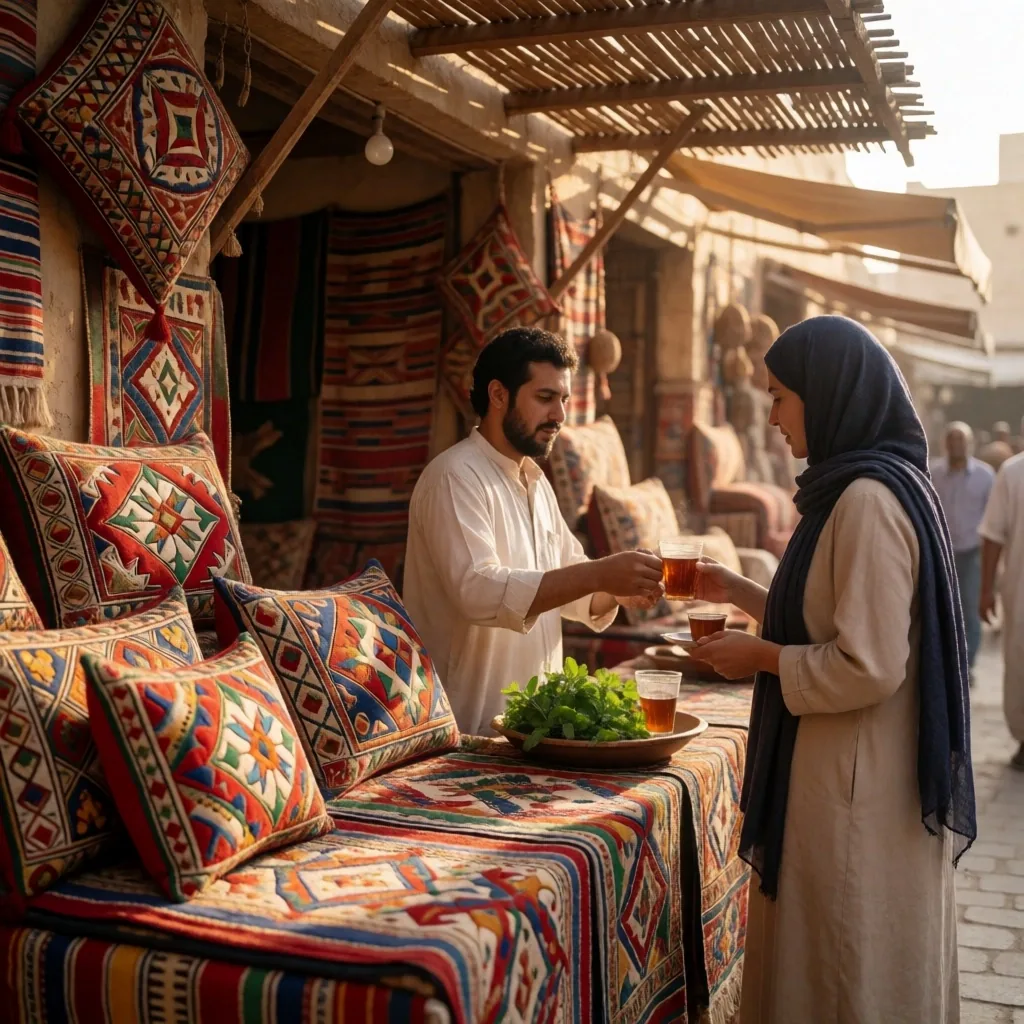
Platform 06 · Navigating the Market Environment
Market interactions are a blend of commerce and social theater
It is common for sellers to engage in conversation that may seem personal to a visitor — asking where you are from, how long you have been traveling, whether you have family. This is simply a part of the local rapport-building process, not an intrusion. The conversation is the product as much as the goods on the shelf.
If you are not interested in an item, a polite but firm "La, shukran" — no, thank you — accompanied by a smile is usually sufficient. Say it once, clearly, and keep walking. Repeating it three or four times only extends the exchange.
There is no need to feel pressured. The interaction is as much about the social exchange as it is about the goods being sold, and a graceful exit is part of the script. Sellers expect browsers; browsing without stopping is perfectly normal.
Platform 05 · Respecting Sacred Spaces
Dress and behavior inside places of worship
When visiting places of worship, specific rules regarding dress and behavior must be followed. Both men and women should ensure their shoulders and legs are covered — loose trousers or a long skirt and a shirt with sleeves will serve you well across most settings.
Women may be asked to cover their hair with a scarf, and many larger sites provide one at the entrance. Silence should be maintained inside, and photography is often restricted during prayer times or in specific areas of the building. Look for signs or follow the lead of other visitors.
Being mindful of these requirements shows a deep respect for the spiritual life of the local community and allows for a more contemplative experience. You are a guest in a space that holds daily meaning — observing quietly is the most genuine way to appreciate it.

Platforms 07 & 08 · Practical Navigation
Small gratuities and gender awareness
Platform 07
Tipping and Small Gratuities
The practice of providing a small gratuity for services is deeply ingrained in the local economy. This is not about the value of the service alone but is a recognized way of acknowledging the effort of workers in various sectors — from the person who carries your bag to the attendant who keeps a restroom clean.
While not mandatory, small amounts for luggage assistance, parking guidance, or restroom maintenance are standard. The gesture matters more than the sum. Carrying small denominations of local currency makes these interactions smoother and avoids the awkwardness of needing change for a larger note.
Keep a pocket of small notes separate from your main funds. When the moment comes — a bag carried, a direction given, a door held — the exchange should feel quick and natural, not like a negotiation.
Platform 08
Gender Dynamics in Public
Social interactions can sometimes be segregated by gender, particularly in more traditional areas or on certain types of public transport. Some trains or buses have designated sections for women to provide a more comfortable environment, and these are usually clearly marked.
For female travellers, being aware of these spaces can enhance the ease of movement. Using them is a personal choice — some women prefer the dedicated sections, others ride in the general carriages without issue. Either is fine; the option exists for comfort, not obligation.
In general, interactions between unrelated men and women tend to be formal and polite, and maintaining this level of formality helps prevent misunderstandings. A direct but respectful tone — friendly without being overly familiar — is the register most locals default to with strangers.

Platform 09 · Environmental and Heritage Sensitivity
A shared responsibility for stone, sand, and shore
Preserving the physical environment and historical sites is a shared responsibility. Avoid touching ancient stone surfaces, as the oils from skin can cause damage over time — a single handprint leaves a residue that thousands of visitors compound. Look closely, photograph from a respectful distance, but let the surface age on its own terms.
Similarly, disposing of waste in designated bins and avoiding the removal of natural items like stones or shells from protected areas is essential. What feels like a small souvenir to one person becomes a missing piece when multiplied across a season of visitors. Leave the ground as you found it.
By acting as a responsible steward of the places you visit, you help ensure that these locations remain intact for future generations of visitors and residents alike. The goal is not to walk on eggshells — it is to walk with awareness, so the next traveller into Egypt finds the same thing you did.
Etiquette Summary · End of Line
Observe first, then match the room
Every egypt travelling guide converges on the same principle: the most respectful traveller is the one who watches before acting. Greet warmly, keep your voice measured, accept generosity with grace, dress with awareness in sacred spaces, carry small notes, and leave every stone where it has rested for centuries.
Begin with "As-salamu alaykum" and let handshakes follow naturally
Keep public volume moderate — match the locals around you
Remove shoes indoors and eat with the right hand
Decline gently with "La, shukran" and a smile
Cover shoulders and legs inside places of worship
Carry small notes for gratuities — the gesture matters
Use designated women's sections on transport if you prefer
Never touch ancient stone — oils from skin cause damage
Continue the Route